Little Blue Pacifier Gets Stuck Ok Baby's Thumb
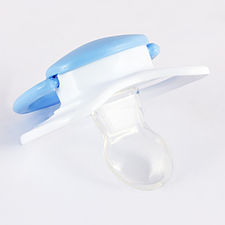

2 types of pacifier: multiple-piece (bluish) and one-piece (pink).
A pacifier is a prophylactic, plastic, or silicone nipple substitute given to an baby to suckle upon betwixt feedings to quiet its distress by satisfying the need to suck when it does not need to swallow. Pacifiers normally have three parts, an elongated teat, a mouth shield, and a handle. The mouth shield is large enough to prevent the child from attempting to take the pacifier into its mouth, and so forecloses the danger that the child volition swallow and so asphyxiate on it.
Pacifiers accept many unlike informal names: binky (American English), dummy (Australian English and British English), soother (Canadian English language and Hiberno English[one]), and Dodie (Hiberno English[ii]).
History [edit]

Baby Comforter design – 1900
Pacifiers were mentioned for the outset time in medical literature in 1473, being described past High german physician Bartholomäus Metlinger in his volume Kinderbüchlein, in later editions retitled Regiment der jungen Kinder ("Caring For Immature Children").
In England in the 17th–19th centuries, a coral was a teething toy made of coral, ivory or bone, oft mounted in silverish as the handle of a rattle.[three] A museum curator has suggested that these substances were used as "sympathetic magic"[4] and that the animal bone could symbolize creature strength to assistance the kid cope with hurting.
Pacifiers were a development of hard teething rings, just they were also a substitute for the softer sugar tits, sugar-teats or sugar-rags [5] which had been in apply in 19th century America. A writer in 1873 described a "sugar-teat" made from "a small-scale piece of one-time linen" with a "spoonful of rather sandy sugar in the centre of it", "gathered ... upwards into a piffling ball" with a thread tied tightly effectually information technology.[6] Rags with foodstuffs tied inside were also given to babies in many parts of Northern Europe and elsewhere. In some places a lump of meat or fat was tied in material, and sometimes the rag was moistened with brandy. German-speaking areas might use Lutschbeutel, cloth wrapped around sweetened bread or poppy-seeds.
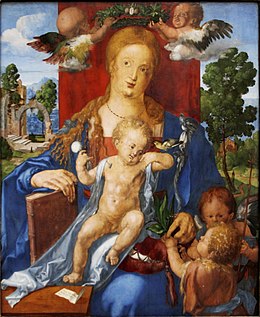
Albrecht Dürer – Madonna with the Siskin, 1506

Albrecht Dürer – Madonna with the Siskin detail, 1506
A Madonna and child painted past Dürer in 1506[7] shows one of these tied-cloth "pacifiers" in the baby's hand.
Pacifiers were settling into their modern form around 1900 when the first teat, shield and handle design was patented in the United states of america as a "baby comforter" by Manhattan pharmacist Christian W. Meinecke.[8] Safety had been used in flexible teethers sold every bit "elastic gum rings" for British babies in the mid-19th century,[nine] and also used for feeding-bottle teats. In 1902, Sears, Roebuck & Co. advertised a "new manner prophylactic teething ring, with ane hard and one soft nipple".[ix] And in 1909 someone calling herself "Auntie Pacifier" wrote to the New York Times to warn of the "menace to health" (she meant dental health) of "the persistent, and, among poorer classes, the universal sucking of a safety nipple sold every bit a 'pacifier'."[ten] In England too, dummies were seen as something the "poorer classes" would use, and associated with poor hygiene. In 1914 a London doctor complained near "the dummy teat": "If information technology falls on the flooring it is rubbed momentarily on the mother's blouse or frock, lipped past the mother and replaced in the baby'south mouth."[11]
Early on pacifiers were manufactured with a selection of black, maroon or white condom, though the white condom of the day independent a certain corporeality of lead. Binky (with a y) was first used in about 1935 as a trademarked make name for pacifiers and other baby products manufactured past the Binky Infant Products Visitor of New York. The brand proper name is currently owned by Playtex Products, LLC every bit a trademark in the U.S. (and a number of other countries).[12]
Drawbacks [edit]

Infants may utilize a pacifier, their fingers or pollex to soothe themselves
There are negative effects from using a pacifier during breastfeeding for healthy babies. The AAP suggests fugitive pacifiers for the offset month. Introducing a pacifier tin lead to the baby ineffectively sucking at the breast and causing "nipple confusion". Babies will take their suck out on the pacifier instead of nursing or condolement nursing at the breast which is good for the babe's brain development [ citation needed ] and the mother's supply. Evidence in premature infants or infants that are not healthy is lacking but shows that it can have benefits.[13] It may have clinical benefits for preterm babies, such as helping them progress from tube to bottle feeding.[14]
Infants who apply pacifiers may accept more ear infections (otitis media).[xv] The effectiveness of avoiding the apply of a pacifier to prevent ear infections is not known.[16]
Although it is commonly believed that using a pacifier will atomic number 82 to dental problems, information technology does not appear to lead to long-term damage if used for less than around three years.[xv] However, prolonged use of a pacifier or other non-nutritive sucking habit (such as finger or coating sucking) has been constitute to pb to malocclusion of the teeth, that is teeth sticking out or non meeting properly when they bite together.[17] [eighteen] This is a common problem and the dental (orthodontic) treatment to correct it tin take a long time and tin can exist expensive. A Cochrane Review of the evidence found that orthodontic braces or psychological intervention (such as positive or negative reinforcement) were effective in helping children terminate sucking habits where that was necessary.[19] An orthodontic brace that used a palatal crib design seems to have been more constructive than a palatal arch blueprint.
There appears to be no strong evidence that using a pacifier delays speech development past preventing babies from practicing their speaking skills.[15]
Benefits [edit]
Researchers take found that use of a pacifier is associated with a substantial reduction in the risk of sudden baby expiry syndrome.[20] [21] They are divided over whether this association is sufficient reason to prefer pacifier use. Some argue that pacifiers should be recommended on the force of an clan, but as back sleeping was recommended on the strength of an association.[22] [23] Others debate that the association is not stiff enough or that the mechanism is unclear.[24]
Pacifiers have also been institute to reduce infants' crying during painful procedures such every bit venipuncture.[25] [26]
Some parents adopt the use of a pacifier to the child sucking their thumb or fingers.
Researchers in Brazil accept shown that neither "orthodontic" nor standard pacifiers prevent dental issues if children continue sucking past the historic period of three years.[27]
It is commonly reported anecdotally that pacifier use amongst stimulant users helps reduce bruxism and thus prevents tooth damage. It is as well known to assist infants to go to sleep and as well keeps infants calm.
Medical policies [edit]
The American Academy of Pediatric Dentistry's "Policy on Thumb, Finger and Pacifier Habits" says: "Most children cease sucking on thumbs, pacifiers or other objects on their own betwixt ii and four years of historic period. All the same, some children continue these habits over long periods of time. In these children, the upper front teeth may tip toward the lip or not come in properly. Frequent or intense habits over a prolonged period of time can bear on the way the child'south teeth seize with teeth together, too as the growth of the jaws and bones that support the teeth."[28]
A study of sudden infant expiry syndrome (SIDS) states that "It seems appropriate to terminate discouraging the utilise of pacifiers." The authors recommend the use of pacifiers at nap time and bedtime throughout the showtime year of life. For breastfeeding mothers, the authors advise waiting until breastfeeding is well established, typically for several weeks, before introducing the pacifier.[29]
The British Dental Health Foundation recommends: "If you tin, avert using a dummy and discourage thumb sucking. With prolonged utilise (come across Drawbacks to a higher place), these can both eventually cause bug with how the teeth abound and develop. And this may demand handling with a caryatid when the kid gets older."[30]
Adult pacifiers [edit]


Three ravers; the woman on the right has a pacifier on a cord around her cervix (2007)
Adult-sized pacifiers, consisting of a standard baby pacifier guard simply a larger, wider nipple, are used by some members of the Adult Baby community. The nipples are often referred to every bit NUK5s, later the NUK make of baby pacifiers manufactured past the German visitor MAPA GmbH. They are sold nether the name NUK Medicpro 50 or NUK Size five.fg. Since the early 2010s, in that location has been the advent of generic, NUK-fashion pacifiers on eBay, which accept both developed-sized silicone nipples and adult-sized face up guards and rings to match.
At techno parties and raves, standard children'due south pacifiers are a common sight, being both used and sold there; a common side effect of entactogen and stimulant drugs, often used by rave attendees, is bruxism (grinding of the teeth), which can upshot in impairment to the teeth, mandible, or natural language. The utilize of dummies, or, alternatively, chewing glue, are anecdotally claimed to help prevent this.
Prevalence of attachments to pacifiers and their psychological functions [edit]
In the tardily 1970s researchers dispelled the notion that pacifiers were psychologically unhealthy and aberrant. Richard H. Passman and Jane Due south. Halonen at the Academy of Wisconsin-Milwaukee traced the developmental course of attachments to pacifiers and provided norms.[31] They plant that 66% of their sample of babies who were three months old in the United States demonstrated at to the lowest degree some attachment, co-ordinate to their mothers. At six months of historic period, this incidence was 40%, and at nine months it was 44%. Thereafter, the rate of attachment to pacifiers dropped precipitously until, at 24 months of historic period and later, information technology was quite rare.
These researchers likewise provided experimental back up for what were then only anecdotal observations that pacifiers do indeed pacify babies.[32] In an unfamiliar playroom, one-year-one-time infants accompanied past their pacifier evidenced more than play and demonstrated less distress than did babies without them. The investigators ended that pacifiers should exist considered to be attachment objects, similar to other security objects like blankets.
Passman and Halonen[31] contended that the widespread occurrence of attachments to pacifiers as well as their importance every bit security objects should reassure parents that they are a normal part of development for a bulk of infants.
See as well [edit]
- Pacifier-activated lullaby
- Security blanket
References [edit]
- ^ "Soothers. Find the total range | Philips".
- ^ "6 tips to become rid of the soother in one case and for all | HerFamily.ie".
- ^ OED; Examples from the Metropolitan
- ^ Victoria & Albert Museum of Childhood. Vam.air-conditioning.uk. Retrieved on 2013-04-14.
- ^ Oxford English language Dictionary
- ^ Jamieson, Cecilia Viets (1873) Ropes of Sand. Chapter 2: Top'southward baby. Letrs.indiana.edu. Retrieved on 2013-04-14.
- ^ Madonna and Siskin. Wga.hu. Retrieved on 2013-04-14.
- ^ Design Patent number D33,212 C.Westward.Meinecke Sep 18 1900
- ^ a b The history of the feeding bottle. babybottle-museum.co.united kingdom of great britain and northern ireland
- ^ Auntie Pacifier (July two, 1909) The "Pacifier" a Menace to Wellness. New York Times.
- ^ ''British Journal of Nursing: The Midwife'' Aug vii 1915. (PDF) . Retrieved on 2013-04-14.
- ^ According to trademark registration documents 1948. Uspto.gov. Retrieved on 2013-04-14.
- ^ Jaafar, Sharifah Halimah; Ho, Jacqueline J.; Jahanfar, Shayesteh; Angolkar, Mubashir (2016-08-xxx). "Outcome of restricted pacifier utilize in breastfeeding term infants for increasing duration of breastfeeding". The Cochrane Database of Systematic Reviews (8): CD007202. doi:ten.1002/14651858.CD007202.pub4. ISSN 1469-493X. PMID 27572944.
- ^ Foster, Jann P.; Psaila, Kim; Patterson, Tiffany (2016-10-04). "Non-nutritive sucking for increasing physiologic stability and nutrition in preterm infants". The Cochrane Database of Systematic Reviews. x: CD001071. doi:x.1002/14651858.CD001071.pub3. ISSN 1469-493X. PMC6458048. PMID 27699765.
- ^ a b c Nelson, AM (December 2012). "A comprehensive review of show and current recommendations related to pacifier usage". Journal of Pediatric Nursing. 27 (six): 690–ix. doi:10.1016/j.pedn.2012.01.004. PMID 22342261.
- ^ Institute for Quality and Efficiency in Health (IQWiG). "Middle ear infections: prevention". Institute for Quality and Efficiency in Health (IQWiG). Retrieved 4 June 2013.
- ^ Vázquez-Nava F, Quezada-Castillo JA, Oviedo-Treviño Due south, et al. (2006). "Association betwixt allergic rhinitis, bottle feeding, non‐nutritive sucking habits, and malocclusion in the primary dentition". Archives of Disease in Childhood. 91 (10): 836–840. doi:x.1136/adc.2005.088484. PMC2066013. PMID 16769710.
- ^ Paroo Mistry; Moles David R; O'Neill Julian; Noar Joseph (2010). "The occlusal effects of digit sucking habits among school children in Northamptonshire (Uk)". Journal of Orthodontics. 37 (2): 87–92. doi:x.1179/14653121042939. PMID 20567031. S2CID 5519168.
- ^ Borrie FRP, Bearn DR, Innes NPT, Iheozor-Ejiofor Z (2015). "Interventions for the cessation of not-nutritive sucking habits in children". Cochrane Database of Systematic Reviews (iii): CD008694. doi:10.1002/14651858.CD008694.pub2. PMC8482062. PMID 25825863.
{{cite periodical}}: CS1 maint: multiple names: authors list (link) - ^ Report in ''Scientific discipline Daily''. Sciencedaily.com (2005-12-08). Retrieved on 2013-04-14.
- ^ Li, De-Kun; Willinger, Marian; Petitti, Diana B.; Odouli, Roxana; Liu, Liyan; Hoffman, Howard J. (2005-12-09). "Use of a dummy (pacifier) during sleep and risk of sudden babe expiry syndrome (SIDS): population based case-control written report". BMJ. 332 (7532): 18–22. doi:10.1136/bmj.38671.640475.55. ISSN 0959-8138. PMC1325127. PMID 16339767.
- ^ Do Pacifiers Reduce the Risk of Sudden Infant Death Syndrome? A Meta-analysis. Pediatrics.aappublications.org. Retrieved on 2013-04-14.
- ^ The Irresolute Concept of Sudden Baby Expiry Syndrome. Aappolicy.aappublications.org. Retrieved on 2013-04-xiv.
- ^ Horne RS; Hauck FR; Moon RY; 50'hoir MP; Blair PS (2014). "Dummy (pacifier) employ and sudden infant death syndrome: potential advantages and disadvantages". J Paediatr Child Health. 50 (3): 170–4. doi:ten.1111/jpc.12402. PMID 24674245. S2CID 23184656.
- ^ Blass EM, Watt LB (1999). "Suckling- and sucrose-induced analgesia in human newborns". Pain. 83 (3): 611–23. doi:ten.1016/s0304-3959(99)00166-9. PMID 10568870. S2CID 1695984.
- ^ Curtis SJ, Jou H, Ali S, Vandermeer B, Klassen T (2007). "A randomized controlled trial of sucrose and/or pacifier equally analgesia for infants receiving venipuncture in a pediatric emergency section". BMC Pediatrics. 7: 27. doi:10.1186/1471-2431-7-27. PMC1950500. PMID 17640375.
- ^ Zardetto, Cristina Giovannetti del Conte, Célia Regina Martins Delgado Rodrigues and Fabiane Miron Stefani (2002). "Effects of Different Pacifiers on the Primary Dentition and Oral Myofunctional Structures of Preschool Children". Pediatric Dentistry. 24 (6): 552–559. PMID 12528948.
{{cite journal}}: CS1 maint: multiple names: authors listing (link) - ^ Thumb, Finger and Pacifier Habits. American Academy of Pediatric Dentistry. aapd.org
- ^ Mitchell, E.A., Blair P.Due south., L'Hoir M.P. (2005). "Should Pacifiers Be Recommended to Prevent Sudden Infant Death Syndrome?". Pediatrics. 117 (v): 1755–1758. doi:10.1542/peds.2005-1625. PMID 16651334. S2CID 19513208.
{{cite journal}}: CS1 maint: multiple names: authors list (link) - ^ Dental care for mother and baby. dentalhealth.org
- ^ a b Passman, R. H., & Halonen, J. S. (1979). "A developmental survey of young children's attachments to inanimate objects". Journal of Genetic Psychology. 134 (2): 165–178. doi:10.1080/00221325.1979.10534051.
{{cite journal}}: CS1 maint: multiple names: authors listing (link) - ^ Halonen, J. S., & Passman, R. H. (1978). "Pacifiers' effects upon play and separations from the mother for the i-year-old in a novel surround". Infant Beliefs and Development. 1: lxx–78. doi:ten.1016/S0163-6383(78)80010-one.
{{cite journal}}: CS1 maint: multiple names: authors listing (link)
External links [edit]
 | Wikimedia Eatables has media related to Pacifiers. |
- "Who Made That Pacifier?", past Dashka Slater, The New York Times Magazine, June xx, 2014
- Information for parents on preventing eye ear infections from PubMed Health
melendezcinissente.blogspot.com
Source: https://en.wikipedia.org/wiki/Pacifier
0 Response to "Little Blue Pacifier Gets Stuck Ok Baby's Thumb"
Postar um comentário